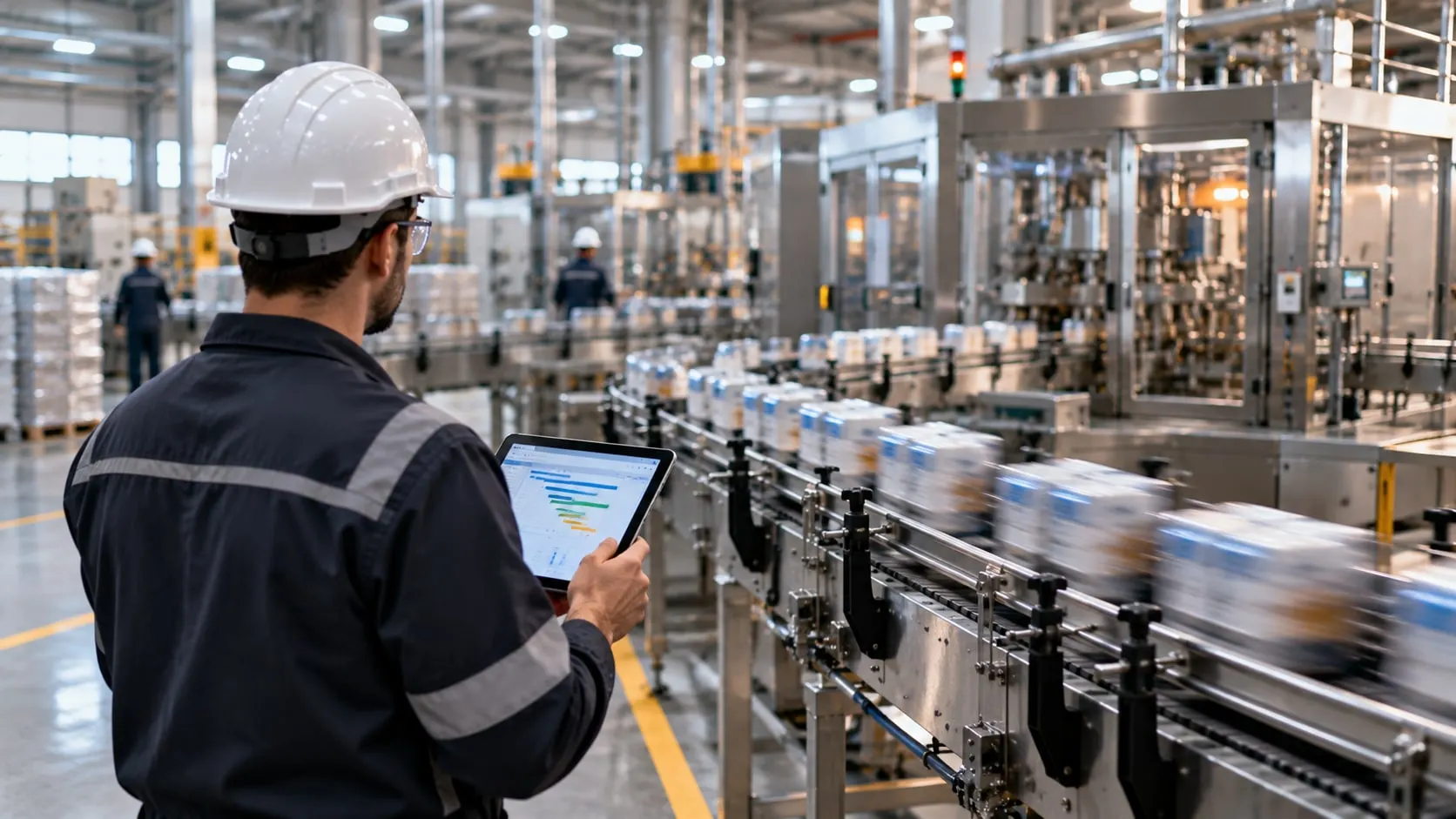
Solution
OEE Software and Production Monitoring System
We build production monitoring and OEE software around your plant, fed directly by machine data, so every shift, work order and stop is measured rather than reported.
Our clients
- Siemens

- Anadolu Isuzu

- BSH
- Tofaş

- Toyotetsu

- Martur

- Turkcell

- Vodafone

- Doğadan

- Pakmaya

- Bross

- Abdi İbrahim

- Nobel İlaç

- Plastimak

- Dalgıç Kalıp

- Barbaros Motor

- Magneti Marelli

- Rözmaş

- Sanel

A production monitoring system reads run, stop and part-count signals straight from PLCs and CNCs and turns them into OEE by machine, shift, product and work order. In many plants that picture still comes from paper shift reports or spreadsheets filled in at the end of the day, where stops are rounded, micro-stops and speed losses disappear, and nobody trusts the OEE number that comes out.
VOLSOFT is a systems integrator, not an off-the-shelf OEE vendor. We connect to your machines without touching the control logic, map raw signals to machine states and counters, add operator input for downtime reasons and scrap, and tie everything to work orders coming from your ERP. Confirmed production flows back to the ERP, so inventory and costing reflect what actually happened on the floor.
Every system we deliver runs on Proxus, installed on your own servers. Data stays on site, is buffered when the network drops, and the same foundation later carries condition monitoring, energy monitoring or tooling use cases without starting over.
What we deliver
OEE Software
-
Automatic machine data
Machine state, cycle time and part counts are read from Siemens S7, Mitsubishi, Omron and Allen-Bradley PLCs and from Fanuc and Heidenhain CNCs. Legacy machines without a usable port are covered through run signals and counter outputs.
-
OEE you can defend
OEE is calculated as availability × performance × quality, with planned stops excluded and ideal cycle time defined per product. The six big losses are tracked separately, so a drop in OEE always points to a cause.
-
Downtime reasons and MTBF/MTTR
Stops are detected from machine signals and operators pick the reason on the shop-floor terminal. We design the reason-code tree with your team and report MTBF and MTTR per asset.
-
Work orders and shifts
Work orders are dispatched to machines, and start, finish, good count and scrap are booked against each order. Shift and operator reports come out without paper.
-
ERP integration
Work orders, bills of materials and production confirmations move both ways with SAP, Microsoft Dynamics and other ERPs, so inventory and costing match the shop floor.
-
Dashboards, andon and reports
Line-side andon screens, live views for supervisors and daily or weekly OEE reports for management. Threshold breaches trigger email or message alerts to the right people.
How a project runs
From discovery to live, step by step
- 01
Site survey and goals
We walk the floor, list machines and controller models, review the network and your current reporting. Together we agree on the KPIs, who uses them and how OEE is defined.
- 02
Pilot line
We connect one line or machine group, validate every signal against what operators see, and test the downtime reason list in real shifts.
- 03
Data model and ERP link
We build an ISA-95 style site, area, line and machine hierarchy and complete the work order and production confirmation interface.
- 04
Rollout
What worked on the pilot is templated and rolled out line by line, with operator terminals, andon screens and reports commissioned along the way.
- 05
Training and support
Operators, supervisors, maintenance and planning are trained on their own views. After go-live we stay on for support and the next use cases.
Built on Proxus
The system is built on Proxus: drivers connect to the machines, edge logic derives states and counts, the historian stores every event, rules compute OEE and downtime, and dashboards and ERP transfer run from the same platform.
Proxus is the industrial data platform built by the VOLSOFT team.
Frequently asked questions
Common questions
What is OEE software?
OEE software measures how much of planned production time a machine actually spends making good parts at the right speed. It collects run, stop, count and reject data from the machines and breaks overall equipment effectiveness into availability, performance and quality. Good OEE software also tells you why each loss happened.
How is OEE calculated?
OEE equals availability × performance × quality. Availability is run time divided by planned production time, performance is ideal cycle time × total count divided by run time, and quality is good count divided by total count. The system calculates all three from machine data rather than manual entries.
What is the difference between a production monitoring system and MES?
A production monitoring system shows what machines are doing: states, counts, downtime and OEE. An MES adds execution on top, such as work order dispatch, material and labor booking, quality checks and traceability. We usually start with monitoring and extend toward MES functions on the same data foundation.
Can you connect older machines?
Yes. Machines without a usable controller interface are connected through run signals, part sensors or counter outputs wired to digital inputs or an existing PLC. Hardware is chosen from standard industrial products; VOLSOFT does the engineering and does not resell devices.
Does the OEE system integrate with SAP or other ERPs?
Yes. Work orders and master data come from the ERP, and production confirmations, scrap and machine times go back to it. We have built these interfaces for SAP, Microsoft Dynamics and several ERPs common in Türkiye.
How long does an OEE software rollout take?
It depends on the number and variety of machines and on the scope of ERP integration, and we pin it down after a site survey. Projects usually start with a pilot line and expand once the numbers are validated with your team.
Related pages
Often looked at together
- Service MES and OEE Implementation Production tracking with automatic OEE, downtime, work orders and shift reports from machine data. Explore →
- Service Machine Data Collection Read-only production data collection from PLCs, CNCs and robots, with control logic left untouched. Explore →
- Service ERP–MES Integration Work-order and production feedback integration with SAP, Dynamics and other ERPs. Explore →
- Industry Plastics and injection molding Cycle time, mold changes, scrap and OEE tracking across injection molding machines. Explore →
- Technology Siemens S7 PLC data collection Read-only data collection from S7-1200, S7-1500, S7-300/400 and S7-200 over S7comm or OPC UA. Explore →

Next step
Let’s turn your goal into a clear engineering scope.
Tell us about your plant, your machines and your goal. An integration engineer will set up a discovery call with you.