Service
Machine data collection and PLC/CNC integration
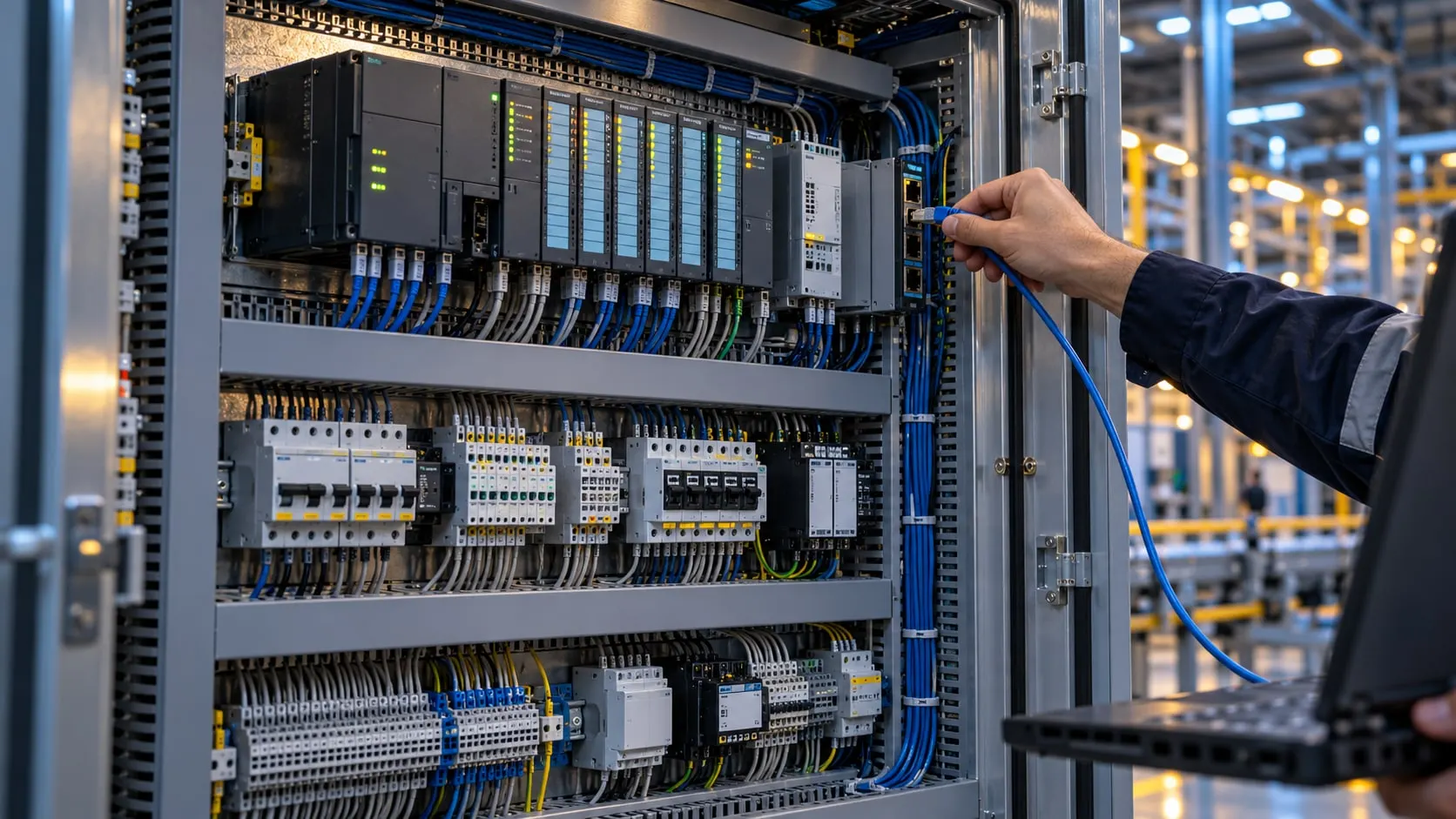
We read production data from PLCs, CNCs and robots without changing a line of control logic. Data is buffered on site and flows to MES, ERP and dashboards under one naming scheme.
Our clients
- Siemens

- Anadolu Isuzu

- BSH
- Tofaş

- Toyotetsu

- Martur

- Turkcell

- Vodafone

- Doğadan

- Pakmaya

- Bross

- Abdi İbrahim

- Nobel İlaç

- Plastimak

- Dalgıç Kalıp

- Barbaros Motor

- Magneti Marelli

- Rözmaş

- Sanel

Machine data collection means moving the signals already inside PLCs, CNCs, robots and meters (running/stopped, part count, cycle time, alarms, temperatures, energy) into a software layer, time-stamped and in order. In most plants the data exists; the hard part is getting it out reliably from mixed brands, controller generations and networks that grew one machine at a time. Numbers typed into a shift log describe what people remember, not what happened.
VOLSOFT is not an automation contractor. We do not write PLC programs, build panels or alter existing control logic. We connect to controllers over their native protocols (S7, EtherNet/IP, MC Protocol, FINS, FOCAS, OPC UA, Modbus) in read-only mode, and any write-back, such as sending a work-order number or recipe, goes to a dedicated data area agreed with the controls engineer and is logged.
Collected data is modeled with meaningful names in a site, line, machine and signal hierarchy instead of raw addresses like DB10.DBW4. Every connection runs on Proxus, which buffers data at the edge when the network or server drops and forwards it in order once the link returns. After the machine data collection and reporting system we built at Bross, the client reported a 15% increase in efficiency in its Clutch review.
What we deliver
Machine Data Collection
-
Read-only connections
We connect to PLCs and CNCs without modifying their programs. Poll rates are set per signal type, fast for status bits and counters and slower for process values, so communication load on the controller stays predictable.
-
Mixed machine fleets
Siemens S7, Allen-Bradley, Mitsubishi MELSEC, Omron, Beckhoff, Fanuc and Heidenhain controllers of different generations are handled in one project. Legacy machines without a network port are read through an input module wired by the plant’s own electrical team.
-
Signal list and tag naming
Which signal is read from which machine, in which unit and with what meaning is agreed up front in a written signal list. Names follow the ISA-95 hierarchy, so a part counter carries the same name and meaning on every screen and report.
-
Downtime and counter logic
Machine state is derived from a combination of run, alarm, manual-mode and starved signals rather than a single bit. Counter resets, rollovers and PLC restarts, all common on the shop floor, are handled explicitly in software.
-
Buffering and time stamps
Data is time-stamped as close to the source as possible and is not lost when the network goes down. Clock synchronization is part of the job, because data stamped by drifting clocks quietly corrupts downtime analysis.
-
OT-friendly architecture
The collection node lives on the OT network and reaches IT through a single, controlled path. PLCs are never exposed directly to the corporate network or the internet.
How a project runs
From discovery to live, step by step
- 01
Site survey and inventory
We record machines, controller models and firmware versions, network topology and access options on site. Where each signal lives is settled together with the controls engineer and maintenance team.
- 02
Signal list and data model
Addresses, units, poll rates and names are signed off per machine in a written list. That list becomes the backbone of the data model used by MES and reporting.
- 03
Pilot line
We connect one line or a handful of machines first and validate values against the HMI and operator observation. Counter and downtime logic are settled here.
- 04
Rollout
The validated template is applied to the remaining machines. Because identical machines share a template, adding one becomes a configuration task.
- 05
Handover and monitoring
Connection health, data gaps and buffer status are monitored. The signal list and architecture document are handed to the plant’s IT/OT team.
Built on Proxus
Every connection is built on the Proxus driver layer: Siemens S7, Allen-Bradley, MELSEC, Omron, Fanuc, Heidenhain, Beckhoff, OPC UA, Modbus, MTConnect and similar, about 30 brands and protocols, managed from one interface. Proxus runs on the customer’s own servers and buffers data through network outages.
Proxus is the industrial data platform built by the VOLSOFT team.
Frequently asked questions
Common questions
How do you collect data from a PLC?
PLC data is read over the network using the controller’s native protocol, such as S7 for Siemens, EtherNet/IP for Allen-Bradley or MC Protocol for Mitsubishi. The addresses to read are defined in a signal list, and values are time-stamped and passed to the software layer. No change to the control logic is required.
Do you need to modify the PLC program?
Usually not; data is read from existing addresses in read-only mode. Occasionally the controls engineer has to change a setting, such as enabling PUT/GET access on an S7-1200/1500, or add a counter the PLC never kept. We do not make those changes ourselves; we specify them in writing and verify them with the responsible team.
Can you collect data from legacy machines?
Yes, in most cases. Older controllers with a communication port are read over serial or legacy Ethernet protocols. Machines with no communication at all are read through an input module for run and count signals, wired by the plant’s electrical team or approved contractor.
What data can be collected from CNC machines?
From Fanuc and Heidenhain controls we typically read operating mode, active program, spindle and feed values, part count, alarms and overrides. What is available depends on the control model and enabled options, which we confirm machine by machine during the survey.
How long does a machine data collection project take?
It depends on the number of machines, the variety of controllers and the state of the network, and is settled after the site survey. Starting with a pilot line and rolling out a validated template keeps the schedule predictable.
Related pages
Often looked at together
- Solution OEE Software OEE software fed by PLC and CNC data, with downtime reasons, work orders and ERP sync. Explore →
- Solution Downtime Tracking Automatic stop detection, reason codes, Pareto analysis and MTBF/MTTR reporting. Explore →
- Technology Siemens S7 PLC data collection Read-only data collection from S7-1200, S7-1500, S7-300/400 and S7-200 over S7comm or OPC UA. Explore →
- Technology Fanuc CNC data collection Reading state, program, part count and alarms from Fanuc Series 0i machines over the network. Explore →
- Industry Plastics and injection molding Cycle time, mold changes, scrap and OEE tracking across injection molding machines. Explore →

Next step
Let’s turn your goal into a clear engineering scope.
Tell us about your plant, your machines and your goal. An integration engineer will set up a discovery call with you.