Wireless IIoT
What is LoRaWAN and how does it work? Gateways, sensors and industrial use
What LoRaWAN is and how it works: gateways, network servers, device classes, sensor choices, LoRaWAN vs NB-IoT, Wi-Fi and 4G, and use in factories.
VOLSOFT Engineering Team ·
Our clients
- Siemens

- Anadolu Isuzu

- BSH
- Tofaş

- Toyotetsu

- Martur

- Turkcell

- Vodafone

- Doğadan

- Pakmaya

- Bross

- Abdi İbrahim

- Nobel İlaç

- Plastimak

- Dalgıç Kalıp

- Barbaros Motor

- Magneti Marelli

- Rözmaş

- Sanel

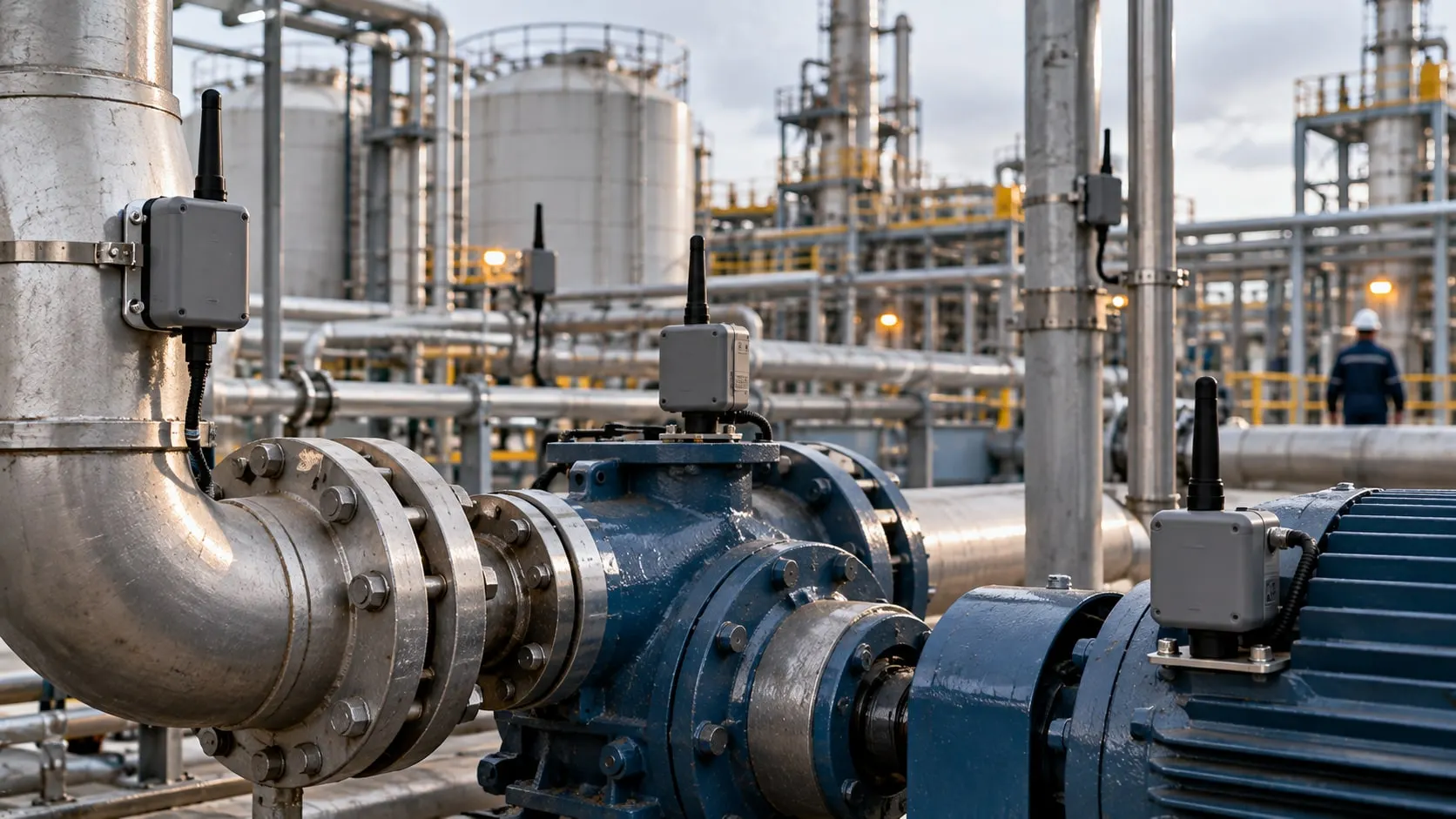
LoRaWAN is an open wireless networking protocol that lets battery-powered sensors send small amounts of data over long distances using very little energy. It runs in unlicensed sub-GHz ISM bands (EU868 in Europe, US915 in North America), is standardized by the LoRa Alliance, and is one of the most widely used LPWAN (low-power wide-area network) technologies. In factories it is used to collect infrequent, small readings, such as temperature, meter pulses, levels and status, from places where running cable is impractical.
This guide explains how LoRaWAN works, what gateways and network servers do, the device classes, how to choose LoRaWAN sensors, how LoRaWAN compares with NB-IoT, Wi-Fi and 4G, and how to integrate it into an industrial data stack.
LoRa vs LoRaWAN
The two terms are often used interchangeably, but they describe different layers:
- LoRa (Long Range) is the physical layer. It defines how the radio signal is modulated using chirp spread spectrum (CSS). This modulation allows very weak signals to be decoded below the noise floor, which is where the long range and low power come from.
- LoRaWAN is the network (MAC) protocol that runs on top of LoRa. It defines how devices join the network, how data is encrypted, the roles of gateways and servers, the device classes, and how data rates are managed.
Put simply, LoRa is the radio and LoRaWAN is the rulebook. Because LoRaWAN is an open standard, sensors, gateways and server software from different vendors can interoperate.
How LoRaWAN works
LoRaWAN networks use a star-of-stars topology. Sensors do not talk to each other or form a mesh; they broadcast directly to gateways. A packet’s journey looks like this:
- The end device takes a reading. A temperature sensor, for example, wakes up on schedule, measures, sends a few bytes of encrypted payload and goes back to sleep.
- Gateways receive the packet. One or more gateways in range hear it. A gateway does not decode the payload; it forwards the packet along with signal metadata (RSSI, SNR).
- The network server processes it. If several gateways forwarded the same packet, the network server deduplicates it, verifies the device identity and message integrity, and can send the device a data-rate adjustment.
- The application server decodes it. The application-layer encryption is removed and a payload decoder turns raw bytes into meaningful values (e.g., 23.4 °C, 51% RH).
- Data reaches the application. The result is typically forwarded over MQTT, HTTP or an integration to monitoring, alarming and reporting software or an industrial data platform.
Spreading factor and data rate
LoRa’s spreading factor (SF7 to SF12) trades range against data rate. A higher SF gives longer range and better building penetration, but the packet stays on air longer, which means a lower data rate and more energy per message. A lower SF is faster and more efficient at short range.
Adaptive data rate (ADR)
With ADR, the network server automatically sets each device’s spreading factor and transmit power based on the signal quality reaching the gateways. For stationary sensors ADR extends battery life and increases network capacity. Mobile devices usually need it configured with care.
Security
LoRaWAN protects data with AES-128 at two levels: a network session key verifies message integrity and device identity, and an application session key encrypts the payload end to end. Even the network server cannot read the content without the application key. Devices join the network in one of two ways: OTAA (Over-the-Air Activation), which derives fresh session keys at each join and is the recommended method, or ABP (Activation by Personalization), which hard-codes the keys into the device.
LoRaWAN device classes: A, B and C
LoRaWAN defines three classes based on when a device listens for downlink messages from the server:
| Class | How it works | Power use | Typical use |
|---|---|---|---|
| A | Opens two short receive windows after each uplink, sleeps otherwise | Lowest | The vast majority of battery-powered sensors |
| B | Adds scheduled receive slots synchronized to a gateway beacon | Moderate | Devices that need commands at predictable intervals |
| C | Listens continuously except while transmitting | Highest | Mains-powered actuators and relay modules |
Every LoRaWAN device must support Class A, and almost all industrial sensor applications run on it.
Choosing a LoRaWAN gateway
The gateway is the backbone of the network on site. Things to look at:
- Frequency plan. It must match your region, e.g., EU868 in Europe and Türkiye or US915 in the United States.
- Indoor or outdoor. Outdoor gateways need a rugged enclosure, an external antenna and surge protection. Inside a plant, steel structures, racking and machines affect the signal, so antenna placement matters as much as the gateway model.
- Backhaul. Ethernet, Wi-Fi or cellular. On a production network, wired Ethernet with PoE is usually the least troublesome.
- Packet forwarder and network server compatibility. The gateway must support a forwarding protocol compatible with the network server you plan to use, such as the open-source ChirpStack or The Things Stack.
- Embedded network server. Some gateways include one. It is handy for small deployments, but once you have several gateways or need high availability, a central network server is the better architecture.
- Coverage plan. How many gateways you need depends on the building, sensor locations and redundancy requirements. A site survey with real measurements beats trusting a datasheet range figure.
LoRaWAN sensor types in industrial settings
LoRaWAN sensors are built for small, infrequent readings. The use cases we see most often in plants:
| Sensor type | Measures | Plant use |
|---|---|---|
| Temperature and humidity | Ambient temperature, relative humidity | Warehouses, cold rooms, raw-material storage, clean rooms |
| Pulse counter / meter reader | Water, gas, compressed-air meter pulses | Consumption tracking, leak detection, energy monitoring |
| Energy meter / current sensor | Current, power, energy | Utility equipment where cabling is difficult |
| Level sensor | Tank and silo levels | Raw material and chemical tank tracking |
| Vibration and temperature sensor | Summary vibration values (e.g., RMS), bearing temperature | Condition monitoring of motors, pumps and fans |
| Door/status contact | Open/closed, present/absent | Door monitoring, simple machine run status |
| Modbus-to-LoRaWAN converter | Modbus data from an existing device | Reading a remote device without cabling |
Vibration sensors deserve a note. LoRaWAN’s data rate cannot carry continuous waveforms, so these sensors compute summary values on the device and send those. That is enough to trend auxiliary equipment, but detailed vibration analysis on critical machines calls for wired, high-sample-rate solutions. Our predictive maintenance page covers this in more depth.
LoRaWAN vs NB-IoT vs Wi-Fi vs 4G
LoRaWAN is not the only option. The right choice depends on how much data you send, how often, how the device is powered and who owns the infrastructure:
| Feature | LoRaWAN | NB-IoT | Wi-Fi | 4G / LTE |
|---|---|---|---|---|
| Spectrum | Unlicensed sub-GHz ISM | Carrier’s licensed LTE spectrum | Unlicensed 2.4 / 5 GHz | Carrier’s licensed spectrum |
| Range | Long (kilometer scale, depending on environment) | Long, depends on carrier coverage | Short (in-building) | Depends on carrier coverage |
| Data rate | Very low | Low | High | High |
| Power use | Very low, long battery operation | Low | High | High |
| Infrastructure ownership | Private network or operator/community network | Carrier | Your own network | Carrier |
| Per-device subscription | Not needed on a private network | SIM subscription | Not needed | SIM subscription |
| Indoor penetration | Good | Good | Moderate | Moderate to good |
| Best fit | Infrequent, small, battery-powered readings | Dispersed sites on carrier infrastructure | High bandwidth, mains-powered devices | Mobile assets, high data, remote sites |
A practical rule: if the device has power and you can run Ethernet, wired always comes first. If the device runs on batteries, sends a small value every few minutes or hours, and cabling is hard, LoRaWAN is a strong candidate. NB-IoT suits dispersed sites with good carrier coverage, and 4G suits mobile assets that need more bandwidth.
Public vs private LoRaWAN networks
LoRaWAN can run on a public or community network operated by someone else, or on a private network you own. Public coverage varies widely by region. In factories the most common and most controlled approach is a private LoRaWAN network: gateways inside the plant, and the network server on the plant’s own server or in a controlled environment. Data stays on site, there are no per-device subscriptions, and the plant owns the network.
Regional rules matter too. Under EU868 (863–870 MHz), which applies in Europe and Türkiye, many sub-bands carry duty-cycle limits such as 1%, meaning a device may transmit only a small fraction of the time. That fits LoRaWAN’s design, but applications that want frequent updates must plan around it from the start.
Getting LoRaWAN data into your industrial data stack
The most neglected part of a LoRaWAN project is what happens after the sensor. Data that stays in a sensor vendor’s cloud dashboard cannot be combined with production data. A sound architecture:
- The network server forwards decoded data over MQTT or HTTP to the plant’s data platform.
- Each sensor is placed in the same naming structure as machine and line data (e.g., an ISA-95 hierarchy): which site, which area, which asset.
- Data is stored in a historian and alarm rules are defined, for example a notification when a cold room leaves its temperature band.
- Battery level, signal quality and last-seen time are monitored too, so sensors that go silent are noticed.
This puts wireless sensor data in the same Unified Namespace as PLC and CNC data, so energy, maintenance and quality reports draw from one source.
Common LoRaWAN mistakes
- Trusting datasheet range. Open-field figures do not hold inside a plant; steel and machinery change the picture. Don’t size the gateway count without a site survey.
- Using LoRaWAN for the wrong job. It is not suited to many-times-per-second data, control, or high-bandwidth applications.
- Setting uplink intervals too short. This drains batteries and runs into duty-cycle limits.
- Skipping payload decoders and the data model. Raw bytes and random device names make data impossible to report on.
- Not monitoring device health. Without battery and signal tracking, a sensor that stopped reporting weeks ago goes unnoticed.
- Leaving data in the vendor cloud. If sensor data does not reach the plant’s data platform, it cannot be correlated with anything else.
How VOLSOFT approaches LoRaWAN projects
VOLSOFT is an industrial software and integration engineering firm; we do not sell sensors or gateways. On LoRaWAN projects we select the network and sensors together with the customer, based on the use case and site conditions, and our job is to integrate that network and those sensors properly into the plant’s data infrastructure.
A typical project defines the use case and measurement points, selects suitable sensor and gateway types with the customer, configures the network server, and sets up payload decoders and the data model. The data then flows into Proxus, the industrial data platform our team develops and uses on every delivery. In Proxus, LoRaWAN data sits in the same Unified Namespace and historian as PLC, CNC and power meter data, and rules, alarms, dashboards and reports are built on that shared data. The platform runs on the customer’s own servers and buffers data when the network is down.
To assess where wireless sensors make sense in your plant, see our industrial IoT solutions page or contact us.
Summary
- LoRaWAN is an open, long-range, low-power wireless protocol for battery-powered sensors; LoRa is its physical layer.
- The network consists of end devices, gateways, a network server and an application server in a star-of-stars topology.
- Classes A, B and C define when a device listens for downlinks; most sensors are Class A.
- EU868 (863–870 MHz) applies in Europe and Türkiye; in factories, private networks are the common approach.
- LoRaWAN is strong for small, infrequent readings; the real value comes from combining that data with production data in one model.