Industrial IoT
What is Industrial IoT (IIoT)? Architecture, applications and how it differs from IoT
What industrial IoT (IIoT) is, IIoT vs IoT, the layers of an IIoT architecture, real factory applications and how to choose an industrial IoT solution.
VOLSOFT Engineering Team ·
Our clients
- Siemens

- Anadolu Isuzu

- BSH
- Tofaş

- Toyotetsu

- Martur
- Turkcell

- Vodafone

- Doğadan

- Pakmaya

- Bross

- Abdi İbrahim

- Nobel İlaç

- Plastimak

- Dalgıç Kalıp

- Barbaros Motor

- Magneti Marelli

- Rözmaş

- Sanel

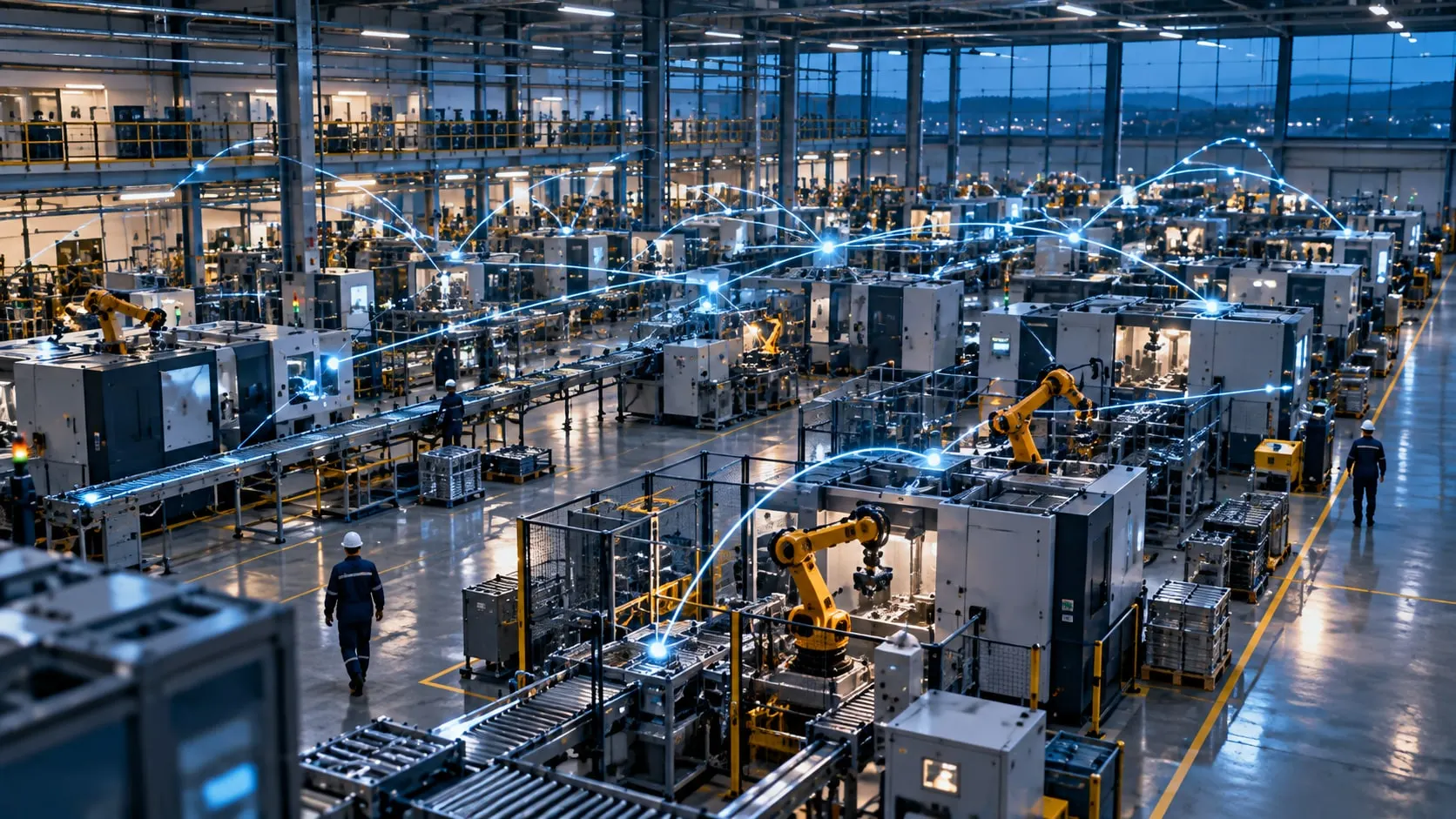
Industrial IoT (IIoT, the Industrial Internet of Things) is the practice of connecting machines, PLCs, CNCs, sensors and meters to software over a network so that production data is collected, processed and used automatically. Its purpose is to base decisions on OEE, downtime, maintenance, energy and quality on real machine data rather than clipboards and spreadsheets. IIoT is the data foundation of Industry 4.0: MES, predictive maintenance and AI-assisted analytics are all built on top of it.
This article explains what industrial IoT is, how IIoT differs from IoT, the layers of a practical IIoT architecture, the applications that create the most value in factories, and what to look for when choosing an industrial IoT solution.
What industrial IoT means in practice
The Internet of Things describes physical devices that send and receive data over a network. Industrial IoT applies that idea to manufacturing, energy, process and infrastructure sites. In a factory, the “things” are injection molding machines, CNC machining centers, presses, compressors, furnaces, power meters and process instruments.
On the shop floor, IIoT means that whether a machine is running, how many parts it has made, which alarm stopped it, how much energy it used and what the mold temperature was all flow into a central system, time-stamped, without anyone writing them down. That data feeds live dashboards and historical analysis alike.
IIoT does not require a new fleet of machines. Most plants run equipment of different ages and brands side by side. A well-built IIoT layer translates that mixed fleet into one common data language without modifying the existing controllers.
IIoT vs IoT
The underlying technology overlaps, but the priorities are very different:
| Topic | IoT (consumer/commercial) | IIoT (industrial) |
|---|---|---|
| Typical devices | Smart home devices, wearables, trackers | PLCs, CNCs, robots, power meters, process sensors |
| Protocols | Wi-Fi, Bluetooth, HTTP/REST, MQTT | OPC UA, Modbus TCP/RTU, Siemens S7, EtherNet/IP, MTConnect, MQTT/Sparkplug |
| Data volume and rate | Low to moderate, intermittent | High and continuous, from milliseconds to minutes |
| Tolerance for loss | A dropped device is often acceptable | Lost data directly affects OEE, traceability and quality |
| Lifecycle | Devices replaced every few years | Machines running for decades, mixed generations |
| Security focus | User data and privacy | Production continuity and protecting the OT network (e.g., IEC 62443) |
| Where it runs | Mostly cloud | Mostly on-premises and at the edge, cloud where it fits |
In short, the hard part of IIoT is not getting a device online. It is getting reliable, contextualized, lossless data out of heterogeneous industrial equipment.
Industrial IoT architecture, layer by layer
An IIoT system is not a single product but a set of connected layers. The architecture that holds up best in the field looks like this:
1. Field layer: machines and sensors
PLCs (Siemens S7, Mitsubishi MELSEC, Omron, Allen-Bradley, Beckhoff), CNC controls (Fanuc, Heidenhain), robots, power meters, temperature, pressure and flow transmitters, and wireless sensors where needed. Most of the data already lives inside the controllers.
2. Connectivity layer: protocols
Every brand speaks its own language. The connectivity layer reads controllers over OPC UA, Modbus, S7, MELSEC, MTConnect and similar protocols. One principle matters most: reading data should never require changing the PLC program. Low-power wireless networks such as LoRaWAN also sit in this layer.
3. Edge layer
Edge computing processes data close to the machine, on an on-site server or industrial PC: filtering, unit conversion, state logic (running, stopped, in setup), buffering when the network drops, and local rules. Less data travels upstream, and what does is meaningful. See edge computing for more.
4. Data model and Unified Namespace
Collected tags need structure: which site, which line, which machine, which signal. A naming scheme based on the ISA-95 hierarchy and a Unified Namespace (UNS) let every application find the same data under the same name. Skip this layer and every new project builds its own point-to-point integration until the system becomes unmanageable.
5. Storage: the historian
A historian keeps time-series data for the long term in a queryable form. Root-causing past downtime, pulling batch history for a customer complaint or training a predictive maintenance model all depend on it.
6. Applications and integration
OEE and production monitoring, downtime analysis, maintenance alerts, energy reports, operator panels, management dashboards, and data exchange with ERP, MES, SQL databases and cloud services live in this layer.
How IIoT relates to SCADA, MES and ERP
A question we hear constantly: “We already have SCADA, why do we need IIoT?” These systems are not competitors; they sit at different layers:
| System | Main job | Typical scope |
|---|---|---|
| PLC / CNC | Control the machine | One machine or cell |
| SCADA | Supervise a process and let operators intervene | A line, a process or an area of the plant |
| IIoT data layer | Collect, model, store and distribute data from many sources | The whole plant, or several plants |
| MES / OEE | Manage production in the context of work orders, shifts, downtime and quality | Production operations |
| ERP | Orders, inventory, cost and planning | The whole company |
SCADA typically serves one control room and its data stays inside that system. The IIoT layer takes data from every source, SCADA included, combines it in a common model and distributes it to MES, ERP, maintenance and energy applications. There is no need to replace existing SCADA; in most projects it simply becomes one of the IIoT layer’s data sources.
Industrial IoT gateways and devices
“Industrial IoT gateway” means different things to different vendors: a protocol converter (say, Modbus RTU to MQTT), an industrial PC running at the edge, or the base station of a wireless network such as LoRaWAN. The device matters less than these questions:
- Which protocols does it speak, and do they cover your machine fleet?
- Can its configuration be managed centrally, or is every unit set up by hand?
- Can it buffer data locally when the network drops?
- How are updates and security patches handled?
In many plants, instead of a scattering of small gateways, edge software running on an on-site server or industrial PC connects to dozens of machines at once, which simplifies both management and maintenance. Extra sensors or gateway hardware are added only for data the controllers cannot provide.
Industrial IoT applications
These are the applications that typically create the most value:
| Application | Data used | What it delivers |
|---|---|---|
| OEE and production monitoring | Run state, counters, cycle time | Real capacity and losses broken down by factor |
| Downtime tracking | Stop start/end, alarms, operator reason codes | Pareto of stop reasons, visibility of minor stops |
| Condition monitoring and predictive maintenance | Vibration, temperature, current, run hours, alarm history | Catching drift before it becomes a breakdown |
| Energy monitoring | Meter and analyzer data | Consumption per machine, line and product; data for ISO 50001 |
| Process and quality monitoring | Temperature, pressure, flow, recipe parameters | Process history and traceability per batch or part |
| Mold and tooling tracking | Shot count, tool ID, cycles | Tool life and maintenance timing |
| ERP–production integration | Work orders, actual counts, scrap | Production confirmation without manual entry |
These look like separate projects, but they share one data foundation. Once run state and part count are collected correctly from a machine, OEE, downtime tracking and ERP confirmation all feed from the same data. That is why it makes sense to start with one use case but build the foundation to carry all of them. Predictive maintenance and energy monitoring are the natural next steps in most plants after OEE.
How to choose an industrial IoT solution
“Industrial IoT solution” can mean very different things: a sensor with a cloud dashboard, software tied to one machine brand, a general-purpose cloud platform, or an on-premises industrial data platform. Questions worth asking:
- Can it connect to your whole fleet? Are there ready-made drivers for your PLC and CNC brands and older machines, or does every machine need custom work?
- Does it touch the PLC program? If data collection requires changing controller logic, that is a risk and often a warranty issue with the machine builder.
- Where does the data live? On-site or in the cloud? Is data buffered or lost when the network drops?
- Is the data model open? Can you reach the data through standard interfaces such as SQL, MQTT and REST, or is it locked in a box?
- Does it integrate with your ERP and existing systems? How does it connect to SAP, Microsoft Dynamics and other ERPs, and to existing SCADA or historian systems?
- Does it scale? Does the architecture change when you move from a pilot line to the whole plant, and then to several plants?
- Who implements and supports it? Commissioning and long-term support on site matter as much as the software.
A step-by-step IIoT project
The sequence we have seen work on the shop floor:
- Define the goal. Not “connect everything,” but something measurable, such as “see stop reasons on the press line.”
- Survey the site. Machine list, controller makes and models, network infrastructure, OT/IT boundaries and existing systems.
- Design the data model. Fix the naming for site, line, machine and signal up front; changing it later is expensive.
- Commission a pilot. Connect a limited set of machines, deliver dashboards and reports, and train operators and maintenance staff.
- Measure and roll out. Measure the pilot with the same definitions, extend the model to other lines and add integrations such as ERP.
Common IIoT mistakes
- Starting with technology. Picking sensors or a platform before the business goal usually ends with dashboards nobody uses.
- Skipping the data model. When every machine names its tags differently, every report needs manual mapping.
- Sending everything to the cloud. Shipping raw high-frequency data unfiltered creates bandwidth and cost problems, and data is lost when the link drops.
- Leaving OT security for later. Uncontrolled bridging of machine and office networks puts production at risk. Segmentation, access control and read-only access should be designed in from day one.
- Leaving operators out. If operators do not enter stop reasons, downtime data cannot be analyzed; the interface must be simple enough for the floor.
- Getting stuck in pilot. Temporary pilot setups do not scale. The pilot should be a small copy of the target architecture.
How VOLSOFT approaches industrial IoT
VOLSOFT is an industrial software and integration engineering firm, a system integrator, based in Çerkezköy, Türkiye. We are not an automation contractor: we do not program PLCs, build panels or sell devices. Our work is the data and software layer above the machines.
On industrial IoT projects we work end to end, from site survey to commissioning: machine data collection, edge, Unified Namespace and data modeling, OEE and downtime tracking, ERP integration, dashboards and reports, training and support. Every delivery runs on Proxus, the industrial data platform our team develops. Proxus connects through drivers for Siemens S7, Allen-Bradley, Mitsubishi MELSEC, Omron, Fanuc, Heidenhain, Beckhoff, OPC UA, Modbus, MTConnect and more, processes data at the edge, keeps it in a Unified Namespace and historian, runs rules and alarms, and forwards data to ERP, databases and the cloud. It runs on the customer’s own servers and buffers data when the network is down.
When hardware is needed, such as wireless sensors or an industrial PC, we work with the customer’s preferred or standard industrial equipment; we do not resell it.
To see where your plant could start, take a look at our industrial IoT solutions and industrial IoT platform pages, or contact us to arrange a site survey.
Summary
- Industrial IoT is the automatic collection and processing of machine and sensor data for production decisions.
- What separates IIoT from IoT: industrial protocols, the need for lossless data, long equipment lifecycles and OT security.
- A sound architecture has connectivity, edge, data model (UNS), historian and application layers.
- OEE, downtime tracking, predictive maintenance and energy monitoring share the same data foundation.
- Start with a measurable pilot, but build the foundation for the whole plant.